Chores are not about adding another worker to the household as early as possible. They help children feel that they belong, contribute, and affect the way their family lives together. At first, aim for willing participation—not an adult standard of perfection.
Four ways to tell whether a chore is appropriate
- Safe: Avoid open flames, sharp tools, harsh cleaning products, and weights beyond the child's ability.
- Specific: “Put these three books on the shelf” is easier to start than “clean your room.”
- Finishable: A first attempt should ideally have a visible ending within 3–10 minutes.
- Easy to demonstrate: An adult can show the task once, then do it together with the child.
Age lists are useful, but they cannot account for every child or home. A six-year-old who has practiced folding towels may be more independent with laundry than an older child who is learning it for the first time. A child may also need a different sequence, a picture prompt, extra supervision, or a quieter time of day. Adjust the job—not the child's worth.
Choose a task that already happens near an established routine. “Put your plate by the sink after dinner” has a built-in cue and a visible ending, which makes it easier to remember than a job scheduled at an unrelated time.
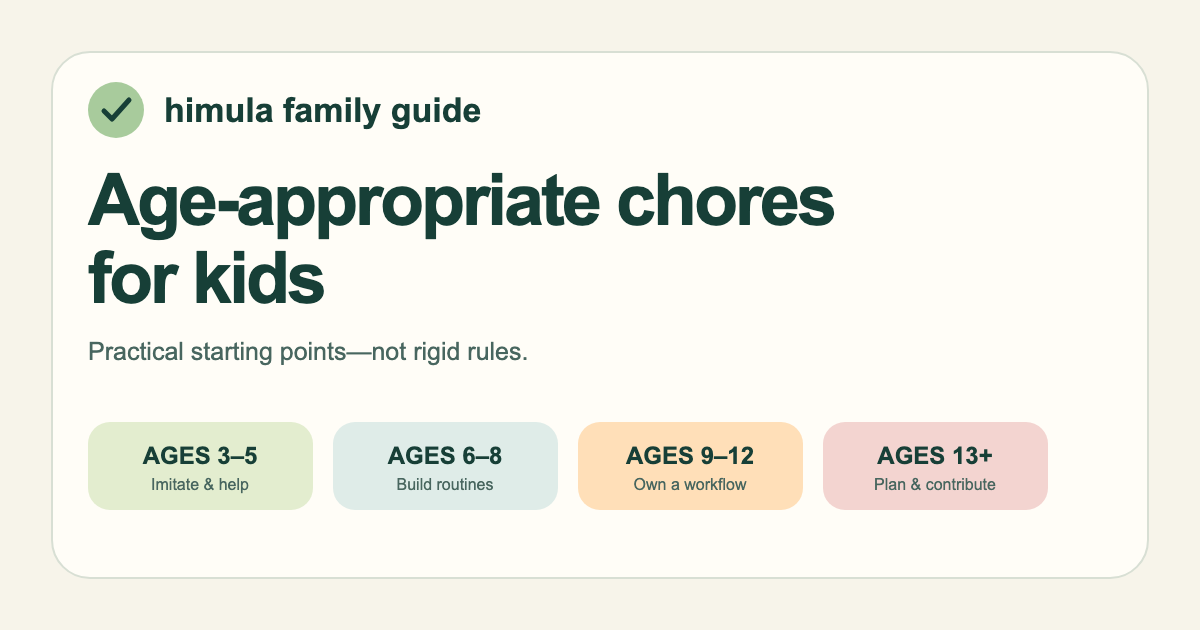
Ages 3–5: Start with imitation and teamwork
Preschoolers often enjoy copying adults, while their attention and motor control are still developing. Choose low-risk chores with few steps and a visible result.
- Put toys into a designated basket.
- Place dirty clothes in the hamper.
- Set out napkins or unbreakable tableware.
- Give plants a small amount of water.
- Line up their own shoes.
- Arrange pillows and bedding with an adult's help.
Parent tip: Give one action at a time. Consistent storage locations and picture labels reduce the memory load. Afterward, describe exactly what happened: “You put every block back in the blue basket.” Expect to work alongside your child; learning the pattern is the achievement at this stage.
Ages 6–8: Build small, consistent responsibilities
Children at this age can follow a short sequence and often care deeply about whether they can “do it themselves.” Start with brief, consistent personal jobs and gradually add shared household work.
- Pack a school bag and prepare items for the next day.
- Clear lightweight items from the table.
- Sort laundry or match clean socks.
- Sweep one clearly defined area.
- Refill a pet's water or feed a pet with supervision.
- Fold towels, pajamas, and other simple clothing.
Parent tip: Limit everyday responsibilities to one or two chores and rotate the rest weekly. Consistency matters more than quantity.
Practical starting chores for a six-year-old
Six-year-olds are often new to managing responsibilities outside a classroom. Choose one job with a clear finish, practice it together, and keep adult control of cleaners, knives, hot surfaces, heavy objects, ladders, and other hazards.
Put clothes in the hamper
Place the hamper where your child changes clothes. Define “done” as clothes inside, with pockets checked by an adult when needed.
Clear their own dishes
Begin with unbreakable items and a clear destination. An adult should handle sharp utensils, hot dishes, and anything heavy.
Put books and toys away
Use one shelf or labeled bin instead of asking for a whole-room cleanup. A visible finish makes the job easier to repeat.
Match clean socks
Give your child a small pile to sort by person or pair. Adults should operate machines and handle laundry products.
For a simple first week, try one daily job—clothes in the hamper after getting dressed—and one helper job, such as clearing an unbreakable plate on Tuesday and Thursday. Review after seven days and change only the part that felt confusing or too long.
The American Academy of Pediatrics recommends realistic expectations and introducing one new task at a time for a school-age child who is new to household responsibilities. Its examples for ages 5–7 include making a bed, clearing the table, putting toys away, sorting laundry, and watering flowers.
Ages 9–12: Practice planning and complete workflows
Tweens can begin combining separate actions into one complete responsibility—for example, cleaning and putting everything away rather than doing only one step.
- Organize their bedroom and study area independently.
- Vacuum a designated room.
- Prepare a simple breakfast or no-cook snack.
- Use the washing machine and hang clothes with guidance.
- Clean a sink and mirror.
- Take responsibility for a consistent pet-care routine.
Parent tip: Agree on what “done” looks like, then let the child decide when to do it within a clear time window. This practices both responsibility and independent planning. When a task involves appliances, cleaning products, knives, heat, pets, or younger siblings, teach the relevant safety steps separately and supervise until the skill is reliable.
Ages 13 and up: Share in household decisions
Teens can manage more complex chores and deserve to be treated as partners in a shared home. Along with completing tasks, invite them into scheduling, shopping, and budgeting decisions.
- Plan and prepare a simple meal independently.
- Manage a family shopping list and check it against a budget.
- Take a turn cleaning the kitchen or bathroom.
- Wash, fold, and put away their own clothes.
- Offer appropriate help to younger family members.
- Help decide how weekly household work is divided.
Parent tip: Give teens both responsibility and a voice. Agree on a deadline and standard, then avoid controlling every step. School, paid work, activities, sleep, and family responsibilities all compete for time, so review the workload rather than assuming resistance is laziness.
Chores by age at a glance
| Age | Good areas of responsibility | Helpful adult support |
|---|---|---|
| 3–5 | Toys, laundry baskets, simple table setting | Demonstrate, work together, give one action at a time |
| 6–8 | Personal organization, simple cleaning, pet care | Use steady routines, clear reminders, and prompt feedback |
| 9–12 | Complete workflows, simple food, household equipment | Agree on standards, offer choices, and reduce reminders |
| 13+ | Cleaning rotations, meals, shopping, and planning | Share decisions, offer real responsibility, and review together |
How to teach a new chore without taking over
Knowing that a child is capable of a chore is not the same as having taught it. Use a gradual handoff so the child learns both the physical steps and the family's standard.
- Show it: Complete the task slowly while naming the important steps. Keep the explanation shorter than the demonstration.
- Do it together: Split the job. A younger child might hold the dustpan while you sweep; an older child might sort laundry while you explain machine settings.
- Watch one attempt: Let the child lead while you answer questions. Correct safety issues immediately, but save cosmetic improvements for the end.
- Hand it over: Put the task in a predictable routine and agree on when it needs to be finished.
- Review calmly: If the result misses the agreed standard, point to the unfinished step and let the child complete it. Redoing the whole job yourself teaches that the responsibility eventually returns to you.
Define “done” before the first reminder
Many chore conflicts are really disagreements about the finish line. Replace broad labels with an observable result:
| Instead of | Try |
|---|---|
| Clean your room | Put clothes in the hamper, books on the shelf, and toys in the two baskets |
| Help with dinner | Put four napkins and four cups on the table before 6:00 |
| Take care of the dog | Fill the water bowl after breakfast and tell an adult when it is done |
| Get ready for school | Get dressed, brush teeth, and put the lunch box in the backpack |
Sample weekly chore plans
These are examples, not targets. A workable plan leaves room for rest and play and does not require a parent to spend the entire day monitoring a chart.
One daily reset
Daily: Put toys in the basket before the bedtime routine.
Once this week: Match clean socks with an adult.
Adult role: Give one prompt and participate.
Personal plus shared
Daily: Pack the school bag after homework.
Three days: Clear their place after dinner.
Adult role: Use the same cue and check the result together.
Own a complete job
Daily: Complete one pet-care responsibility.
Weekly: Vacuum one room by Sunday afternoon.
Adult role: Agree on timing, then reduce reminders.
Plan and contribute
Personal: Manage their own laundry each week.
Shared: Cook one simple meal or clean one common area.
Adult role: Coordinate around the teen's real schedule.
Should chores earn rewards or allowance?
There is no single system that fits every family. The important part is that children can understand the difference between belonging, learning, and earning.
- Family contribution: A small set of ordinary responsibilities can be expected because everyone helps care for the home.
- Learning support: Praise, a sticker chart, points, or Pet Coins in ChorePaws can make early progress visible while a routine is becoming familiar.
- Optional paid work: Families who use allowance can reserve payment for extra jobs beyond the normal list, agreeing on the amount and finish line in advance.
Watch what the system changes. If a child begins negotiating over every small contribution, simplify it. If a chart reduces reminders and helps the child notice progress, it is doing useful work. Rewards are a tool for feedback; they do not need to become the reason a family member helps.
For options you can plan around real time and cost, use our non-monetary chore reward menu.
“You checked the floor and put the last two blocks away” gives a child more information than “good job.” Specific feedback names the useful action without turning the child into either a success or a failure.
When a chore chart stalls, change one part of the plan
A chart cannot tell you what is getting in the way. Start with the pattern you see, then change one part of the task or chart for the next few days. This is a practical reset, not a test of a child's motivation.
| What you notice | Change for the next try |
|---|---|
| The child does not know how to begin. “Clean your room” has too many hidden steps. | Replace it with one first action: “Put clothes in the hamper.” Practice that action together before adding another. |
| You disagree about whether it is done. “Make the bed” means something different to each of you. | Write the finish line: “Pull up the blanket and put the pillow at the head of the bed.” Check that result together once. |
| The reminder arrives at the wrong moment. The chart is across the house or the task competes with leaving. | Put the chart beside the backpack, toy shelf, or other action point. Pair the task with a stable cue such as after breakfast. |
| The job is done but the chart stays blank. | Decide whether adding the mark is part of the task. If not, use one predictable family check-in instead of treating a missed mark as an unfinished chore. |
| The reward creates a promise you cannot keep. | For an earned reward, agree on a new time or one available menu option. Make future menus smaller and name the time before the work begins. |
Use the chart adjustment notes to make the next version smaller, or see the reward examples when the promise itself needs a reset.
If reminders turn into arguments
Move the reminder out of the relationship when possible. Attach the chore to a stable cue (“after breakfast”), use a chart in the place where the task happens, or agree on one check-in time. Avoid issuing a stream of new instructions from another room.
If the work is consistently unfinished
Check one variable at a time: Does the child know every step? Is the standard visible? Is the task safe and physically manageable? Is there enough time? Has the schedule changed? Practice the missing part instead of treating every incomplete job as a motivation problem.
If siblings compare workloads
Talk about time and responsibility rather than counting tasks. One child may have two five-minute jobs while another has one twenty-minute job. Rotate chores that nobody enjoys and let children take part in the next week's plan.
When several children share the list, use the editable family chore chart to name an owner, timing, and finish standard for each job. It also includes a manual note for temporary swaps.
If your child needs more support
Use shorter steps, picture cues, timers, paired work, or a quieter transition. Children differ in motor skills, attention, sensory needs, and the ease with which they switch activities. Persistent difficulty with everyday responsibilities at home and in other settings is worth discussing with your child's pediatrician or another qualified professional.
Make the first week deliberately easy
Choose one or two jobs, teach them, and review after seven days. Do not fill every row simply because a chart has space. When the routine works with fewer prompts, add one responsibility or allow the child to take over more of the sequence.
- Ask your child which task they want to learn first.
- Write the task as a visible action with a clear time or cue.
- Practice it together before expecting independent completion.
- Notice effort and follow-through promptly.
- At the end of the week, keep, change, or remove the task together.
Sources and further reading
This guide offers general educational information, not medical or developmental advice. We used the following professional resources to check our recommendations about age-appropriate expectations, routines, encouragement, and family responsibility:
- American Academy of Pediatrics: Age-Appropriate Chores for Children
- American Academy of Child and Adolescent Psychiatry: Chores and Children
Frequently asked questions
At what age can children start doing chores?
Children can begin with low-risk jobs such as putting away toys or carrying safe objects once they can follow a simple direction and enjoy copying adults. At first, participation matters more than doing the job perfectly or independently.
Should children always be rewarded for doing chores?
Not necessarily. Shared family responsibilities should not depend entirely on material rewards. Praise, time together, or a simple point system can help a child see early progress, then gradually become less important as the routine takes hold.
What should I do when my child refuses a chore?
First check whether the job is too large, the finish is unclear, or the timing is poor. Reduce it to one action that takes only a few minutes, offer a limited choice, and give prompt, specific feedback when it is complete.
How many chores should a child have?
There is no universal number. Begin with one daily personal responsibility and one small household contribution. Add another only when the current routine is predictable and still leaves enough time for school, rest, relationships, and play.
Should siblings have the same chores?
Equal does not have to mean identical. Divide work according to safety, ability, schedule, and the time each job takes. Rotate unpopular tasks when practical, and explain the reason for differences without comparing children.
Should chores be tied to allowance?
Families take different approaches. One balanced option is to keep a few basic chores as unpaid family responsibilities while offering optional paid jobs for work beyond the normal routine. Whichever system you choose, make the rules clear before the work begins.