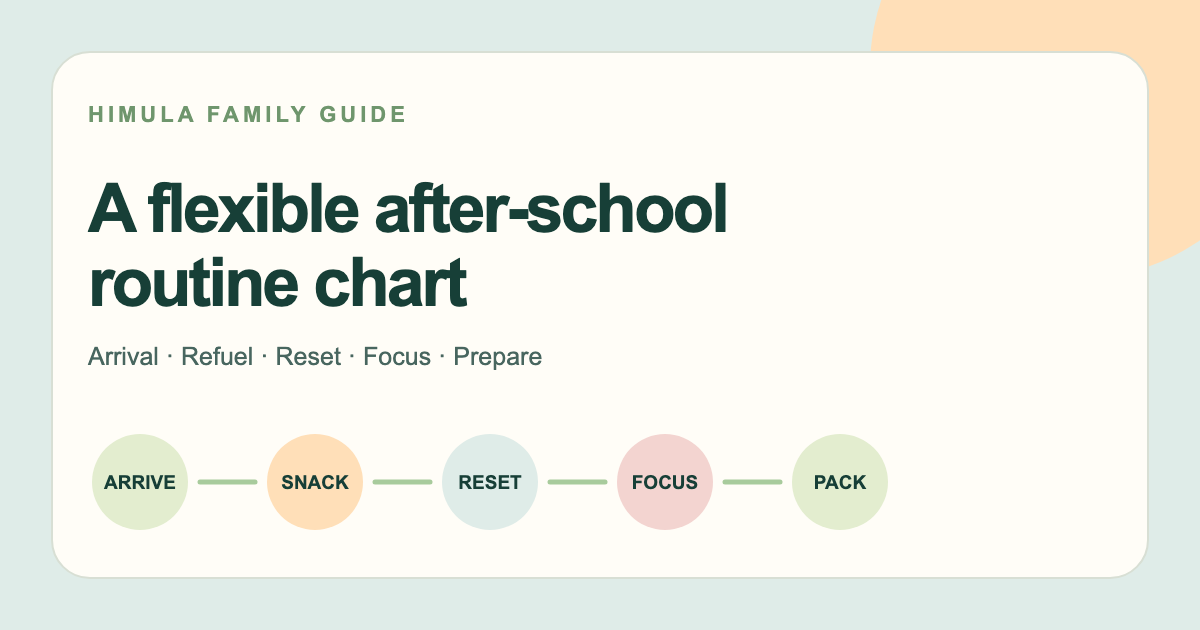
Start with five simple parts
- Arrive and reconnect. Put shoes, coat, and backpack in their usual places. Share any schedule changes.
- Snack and water. Give your child a predictable chance to refuel.
- Move or decompress. Choose active play, outdoor time, quiet play, or a short rest based on what helps your child reset.
- Schoolwork and one home task. Keep both specific. “Read for 15 minutes” and “clear your dishes” are clearer than “do everything.”
- Prepare for tomorrow. Use a short school bag checklist, choose needed items, and place them by the exit.
The American Academy of Pediatrics suggests leaving room after school for food, physical activity, rest, and schoolwork while choosing an order that suits the child. Its guide to the importance of family routines recommends a flexible balance instead of an overly rigid structure.
Three versions to try
Release some energy
Arrival → snack → active play → schoolwork → clear dishes → prepare backpack.
Lower the stimulation
Arrival → snack → reading or quiet play → one home task → schoolwork → prepare backpack.
Keep the essentials
Arrival → snack → pack activity gear → activity → short school check → prepare for tomorrow.
Do not treat a template as a test. If your child comes home exhausted, hungry, or upset, connection and basic needs come first. A shorter routine your family can repeat is more useful than a perfect chart that gets ignored.
Make each line observable
Use words that tell everyone when the step is finished. Replace “get organized” with “hang backpack on the hook.” Replace “do homework” with the actual assignment or a defined check-in. For tasks that require adult review, write that into the routine.
An example after-school routine
3:30 Backpack on hook, snack, and water
3:50 Outdoor play or quiet reset
4:20 Homework or reading
4:45 Clear snack dishes
4:50 Pack backpack for tomorrow
These times are only an example. Many families will use an untimed checklist instead. Sports, after-care, transportation, homework needs, and adult availability all change the right schedule.
Once the evening steps are stable, connect them to a separate school morning routine chart. That keeps night-before preparation out of the morning list.
Open the free weekly chore chart, choose the after-school template, and edit the six rows for your schedule. It works in the browser without an account.
Review the routine once a week
- Ask which step is most often skipped and why.
- Move difficult work to the time when your child has more energy.
- Remove duplicate reminders and keep the chart easy to scan.
- Update responsibilities as skills and schedules change.
When a digital routine helps
A printed chart stays visible without a device. A digital tool can handle rewards and repeating schedules. ChorePaws Free supports one active member and up to three active one-time tasks; repeating tasks and weekly goals are Plus features. Read our paper vs. digital chore chart comparison before choosing.
Source and scope
This guide offers general educational information, not medical or developmental advice. We used the American Academy of Pediatrics family-routines guidance to check the core routine recommendations.